Showing posts with label ecology. Show all posts

Tuesday, August 30, 2022

The Journey of Trees by Zach St. George


Summary: (Amazon) Forests are restless. Any time a tree dies or a new one sprouts, the forest that includes it has shifted. When new trees sprout in the same direction, the whole forest begins to migrate, sometimes at astonishing rates. Today, however, an array of obstacles―humans felling trees by the billions, invasive pests transported through global trade―threaten to overwhelm these vital movements. Worst of all, the climate is changing faster than ever before, and forests are struggling to keep up.

A deft blend of science reporting and travel writing, The Journeys of Trees explores the evolving movements of forests by focusing on five trees: giant sequoia, ash, black spruce, Florida torreya, and Monterey pine. Journalist Zach St. George visits these trees in forests across continents, finding sequoias losing their needles in California, fossil records showing the paths of ancient forests in Alaska, domesticated pines in New Zealand, and tender new sprouts of blight-resistant American chestnuts in New Hampshire. Everywhere he goes, St. George meets lively people on conservation’s front lines, from an ecologist studying droughts to an evolutionary evangelist with plans to save a dying species. He treks through the woods with activists, biologists, and foresters, each with their own role to play in the fight for the uncertain future of our environment.

An eye-opening investigation into forest migration past and present, The Journeys of Trees examines how we can all help our trees, and our planet, survive and thrive.


Review: 

WSJ: https://www.wsj.com/articles/the-journeys-of-trees-review-giants-in-transit-11602256237


Interviews:

Powell's Bookshop in Portland: https://www.youtube.com/watch?v=oG9Bjm_7s7o


NPR: https://www.npr.org/2020/07/28/896030567/believe-it-or-not-forests-migrate-but-not-fast-enough-for-climate-change

(wwnorton.com)


Author's Website: https://zachstgeorge.com/


Articles/Programs:


Giant Sequoia Genetic Conservation Program: http://www.torreyaguardians.org/sequoia-lunak-2015.pdf


Redwood Genome Project: https://www.savetheredwoods.org/project/redwood-genome-project/


Discussion Questions: 


(npr.org)


Friday, July 1, 2022

The Seaweed Chronicles by Susan Shetterly


Summary (Amazon): “Seaweed is ancient and basic, a testament to the tenacious beginnings of life on earth,” writes Susan Hand Shetterly in this elegant, fascinating book. “Why wouldn’t seaweeds be a protean life source for the lives that have evolved since?” On a planet facing environmental change and diminishing natural resources, seaweed is increasingly important as a source of food and as a fundamental part of our global ecosystem.


In 
Seaweed Chronicles, Shetterly takes readers deep into the world of this essential organism by providing an immersive, often poetic look at life on the rugged shores of her beloved Gulf of Maine, where the growth and harvesting of seaweed is becoming a major industry. While examining the life cycle of seaweed and its place in the environment, she tells the stories of the men and women who farm and harvest it—and who are fighting to protect this critical species against forces both natural and man-made. Ideal for readers of such books as The Hidden Life of Trees and How to Read Water, Seaweed Chronicles is a deeply informative look at a little understood and too often unappreciated part of our habitat.

Reviews: 


(Bangor Daily News)  Sheep and Flat Island

Videos and Interviews:
1. Interview: Surry Historical Society: https://www.youtube.com/watch?v=Fu5Puj77aqI

(medium.com)


Discussion Questions (Anne will be leading the discussion and also wrote the questions)


(WSJ.org)


Wednesday, March 4, 2020

Buzz, Sting, Bite: Why We Need Insect by A. Sverdrup-Thygeson


Summary: (Amazon) Insects comprise roughly half of the animal kingdom. They live everywhere—deep inside caves, 18,000 feet high in the Himalayas, inside computers, in Yellowstone’s hot springs, and in the ears and nostrils of much larger creatures. There are insects that have ears on their knees, eyes on their penises, and tongues under their feet. Most of us think life would be better without bugs. In fact, life would be impossible without them.

Most of us know that we would not have honey without honeybees, but without the pinhead-sized chocolate midge, cocoa flowers would not pollinate. No cocoa, no chocolate. The ink that was used to write the Declaration of Independence was derived from galls on oak trees, which are induced by a small wasp. The fruit fly was essential to medical and biological research experiments that resulted in six Nobel prizes. Blowfly larva can clean difficult wounds; flour beetle larva can digest plastic; several species of insects have been essential to the development of antibiotics. Insects turn dead plants and animals into soil. They pollinate flowers, including crops that we depend on. They provide food for other animals, such as birds and bats. They control organisms that are harmful to humans. Life as we know it depends on these small creatures.

With ecologist Anne Sverdrup-Thygeson as our capable, entertaining guide into the insect world, we’ll learn that there is more variety among insects than we can even imagine and the more you learn about insects, the more fascinating they become.


(NY Times)


Reviews:


Tuesday, February 28, 2017

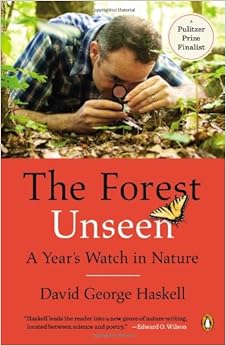
The Forest Unseen: A Year's Watch in Nature by David G. Haskell


Summary from Amazon: 
"In this wholly original book, biologist David Haskell uses a one- square-meter patch of old-growth Tennessee forest as a window onto the entire natural world. Visiting it almost daily for one year to trace nature's path through the seasons, he brings the forest and its inhabitants to vivid life.

Each of this book's short chapters begins with a simple observation: a salamander scuttling across the leaf litter; the first blossom of spring wildflowers. From these, Haskell spins a brilliant web of biology and ecology, explaining the science that binds together the tiniest microbes and the largest mammals and describing the ecosystems that have cycled for thousands- sometimes millions-of years. Each visit to the forest presents a nature story in miniature as Haskell elegantly teases out the intricate relationships that order the creatures and plants that call it home.
Written with remarkable grace and empathy, The Forest Unseen is a grand tour of nature in all its profundity. Haskell is a perfect guide into the world that exists beneath our feet and beyond our backyards."
Book Reviews:
Video: In this Franke lecture on January 29th, 2014, David Haskell, Professor of biology at Sewanee: The University of the South, gives a talk on biology, literature and contemplative practice:

Discussion Questions by Donna:
1.  How does author use the concept of the mandala, in this case a square meter of forest, as a lens to study so called “larger” topics of biology, ecology, evolution, biochemistry, etc.?  Cite some of your favorite examples.

2.  In his essay on fireflies, he states “When children chase after fireflies, they are not pursuing beetles but catching wonder.  When wonder matures, it peels back experience to seek deeper layers of marvel below.  This is science’s highest purpose.”
How does Haskell use dramatic stories of life in the mandala to fuel that sense of wonder in folks of all ages?

3. How does he use extraordinary numbers to stoke our amazement of things unseen, e.g. joules in a sunflower seed, kilometers of seed dispersal, miles of photons’ travel, etc.?

4. How does he treat some controversial topics like logging practices, wolf/coyote populations, or other environmental issues like climate change?

5. E.O.Wilson states that “Haskell’s nature writing…. is located between science and poetry.”  Did you enjoy his style?  What were some favorite metaphors he used to describe the flora and fauna in the mandala?  Did you find his style too “flowery” or dramatic?

6.  How does Haskell weave in topics of human nature, and human’s place in nature?