Showing posts with label wildlife. Show all posts

Thursday, June 3, 2021

An Elephant in my Kitchen by Françoise Malby-Anthony


Summary (modified from Amazon): Sequel to The Elephant Whisperer, which was written by Lawrence Anthony, in this book, his wife Françoise writes about her experiences after she has to carry on after his death. She never expected to find herself responsible for a herd of elephants with a troubled past. A chic Parisienne, she with Lawrence founded a game reserve but after his death, Françoise faced the daunting responsibility of running Thula Thula without him. Poachers attacked their rhinos, their security team wouldn’t take orders from a woman and the authorities were threatening to cull their beloved elephant family. On top of that, the herd’s feisty new matriarch Frankie didn’t like her.

In this heart-warming and moving book, Françoise describes how she fought to protect the herd and to make her dream of building a wildlife rescue centre a reality. She found herself caring for a lost baby elephant who turned up at her house, and offering refuge to traumatized orphaned rhinos, and a hippo called Charlie who was scared of water.

(https://www.anelephantinmykitchen.com/the-story)


Reviews:

1. http://www.poachingfacts.com/resources/book-reviews/an-elephant-in-my-kitchen-review/

2. Kirkus Reviews: https://www.kirkusreviews.com/book-reviews/francoise-malby-anthony/an-elephant-in-my-kitchen/

Website for the bookhttps://www.anelephantinmykitchen.com/

One of the Authors' Websiteshttp://www.katjawillemsen.com/home.html

(https://www.thulathula.com/south-african-safari/)


Thula Thula Game Preservehttps://www.thulathula.com/

Groups to support:

1. South African Conservation Fund: https://www.saconservation.fund

2. Four Paws International: https://www.four-paws.org/

3. My Baby Rhinos - Children Book: https://www.youtube.com/watch?v=-0NKp7SyhKAhttps://www.facebook.com/mybabyrhinos/

4.Elephant Orphanage in Kenya, which Cheryl shared: https://www.sheldrickwildlifetrust.org/

Other:

1. African Lullaby: Thula Babahttps://www.youtube.com/watch?v=5cLFlKcXmSk

2. Poaching Rhinos Article: https://www.reuters.com/world/africa/rhino-poachers-are-back-after-south-africa-eases-lockdown-restrictions-2021-05-03/


Interviews:

1. From Thula Thula Wildlife Reserve: https://www.youtube.com/watch?v=8_-Sa826KwA

2. https://anglophone-direct.com/an-elephant-in-my-kitchen/

3. https://www.youtube.com/watch?v=7a8F1znHP3c

Videos:

1. Video with Lawrence: https://www.youtube.com/watch?v=UTtcz8Vuor0

Discussion Questions: (John will be leading the discussion.)


(Reader's Digest)


Friday, September 25, 2020

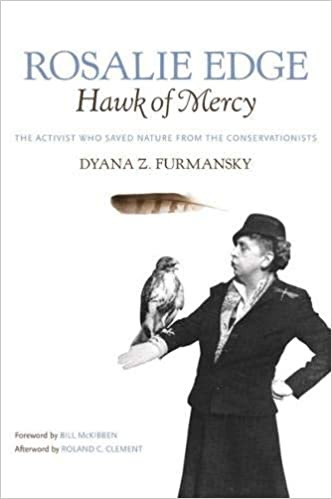
Rosalie Edge: Hawk of Mercy by Dyana Z.Furmansky

Summary (from Amazon): Rosalie Edge (1877-1962) was the first American woman to achieve national renown as a conservationist. Dyana Z. Furmansky draws on Edge’s personal papers and on interviews with family members and associates to portray an implacable, indomitable personality whose activism earned her the names “Joan of Arc” and “hellcat.” A progressive New York socialite and veteran suffragist, Edge did not join the conservation movement until her early fifties. Nonetheless, her legacy of achievements―called "widespread and monumental" by the New Yorker―forms a crucial link between the eras defined by John Muir and Rachel Carson. An early voice against the indiscriminate use of toxins and pesticides, Edge reported evidence about the dangers of DDT fourteen years before Carson's Silent Spring was published.

Today, Edge is most widely remembered for establishing Hawk Mountain Sanctuary, the world's first refuge for birds of prey. Founded in 1934 and located in eastern Pennsylvania, Hawk Mountain was cited in Silent Spring as an "especially significant" source of data. In 1930, Edge formed the militant Emergency Conservation Committee, which not only railed against the complacency of the Bureau of Biological Survey, Audubon Society, U.S. Forest Service, and other stewardship organizations but also exposed the complicity of some in the squandering of our natural heritage. Edge played key roles in the establishment of Olympic and Kings Canyon National Parks and the expansion of Yosemite and Sequoia National Parks. Filled with new insights into a tumultuous period in American conservation, this is the life story of an unforgettable individual whose work influenced the first generation of environmentalists, including the founders of the Wilderness Society, Nature Conservancy, and Environmental Defense Fund.

Reviews:

https://greengroundswell.com/rosalie-edge-hawk-of-mercy-book-review/2013/08/22/

(wikipedia)

Articles:

1. Audubon: https://www.audubon.org/news/unpacking-rosalie-edge-slowly-stories-hawk-mercy-doesnt-tell

2. Million Trees: https://milliontrees.me/2014/09/12/rosalie-edge-conservation-hero/

Archive Catalog of Bird Lore written by Frank Chapman for NAAShttps://catalog.hathitrust.org/Record/000497136

Pelican Island in Floridahttps://www.fws.gov/refuge/pelican_island/about/history.html

History of National Association of Audubon Societies (NAAS)https://www.audubon.org/about/history-audubon-and-waterbird-conservation

Videos and Interviews with Author:

1. By her daughter: https://www.youtube.com/watch?v=jk3DMgvquTI

2. U.S. Fish and Wildlife Service: https://www.facebook.com/watch/live/?v=300224014335245&ref=watch_permalink

3. Hawk Mountain: https://www.youtube.com/watch?v=iVHIXqJYanA

4. Wildlife Center in VA: https://www.wildlifecenter.org/episode-13-hawks-falcons

Hawk Mountain Sanctuary Website: https://www.hawkmountain.org/

Discussion Questions: 

1.  Discuss who Edge was and how she became a "citizen-scientist and militant political agitator".  What events influenced and "awakened"her?  Discuss her travels, writings, involvement with the suffragette movement, social life, marriage, children, etc.

2.  Discuss the origins and evolution of The National Association of Audubon Societies (NAAS) organization, "the nation's oldest, largest, wealthiest and most prestigious bird protection organization", including its early leaders such as Grinnell, Chapman, and Pearson.  Discuss NAAS' relationship with the AOU (American Ornithological Society), the American Museum of Natural History and Bureau of Biological Survey as well as the Winchester Arms Co. and the Vermilion Bay Hunt Club and the conflicts that ensured.  (p. 98-)

3.  What does "conservation" mean to you?  What does the term "sentimentalist" mean?  What does "preservationist" mean?

4.  In 1929, Edge received a package in Paris containing the pamphlet, "A Crisis in Conservation".  Discuss why it was written, what event provoked it to be written and who were the writers.  What impact did it have on Edge?  (p.88-, 106-)

5.  Discuss Edge's relationship and interactions with the NAAS Board including her writings and the various people she worked with including Hornaday, Van Name and Brant and even Peterson and how it led to her founding the ECC (Emergency Conservation Committee).  (p. 110-, 118-, 124)

6.  Why does Edge hire the cofounder and director of the ACLU, Roger Baldwin, to represent her in a lawsuit against the NAAS?  What is the result and impact?  (126-) Discuss further major events that she fought against including the Rentals of Sanctuary in the NAAS budget, (p. 138), Yellowstone's pelicans (p. 141), fur trapping, Bear Refuge (p. 140), and King's Canyon (p. 228-), etc.

7.  The term ecosystem was not readily used in the early 1900s but Edge evokes this concept at NAAS meetings and congressional hearings.  (p. 143-) What impact and vision did it provide?

8.  Edge kept her activist and social lives separate.  At the Colony Club though, she was once asked, "What do you do when you look at a bird?"  (p. 150)  How would you respond?

9.  Discuss Edge's creativity, advocacy work, and navigation of numerous relationships (Van Name, Secretary Ickes, Brant, Superintendent Thompson, etc.) from creating the Hawk Mountain Sanctuary to helping create the Olympic National Park and also saving the Yosemite Sugar Pines.

10.  What impact did Edge have on the conservation movement as a whole and which organizations and individuals continued the fight, who were inspired by her?


(Audubon.org)


Monday, March 5, 2018

The Urban Bestiary by Lyanda L. Haupt


Summary: (from Amazon):
"In THE URBAN BESTIARY, acclaimed nature writer Lyanda Lynn Haupt journeys into the heart of the everyday wild, where coyotes, raccoons, chickens, hawks, and humans live in closer proximity than ever before. Haupt's observations bring compelling new questions to light: Whose "home" is this? Where does the wild end and the city begin? And what difference does it make to us as humans living our everyday lives? In this wholly original blend of science, story, myth, and memoir, Haupt draws us into the secret world of the wild creatures that dwell among us in our urban neighborhoods, whether we are aware of them or not. With beautiful illustrations and practical sidebars on everything from animal tracking to opossum removal, THE URBAN BESTIARY is a lyrical book that awakens wonder, delight, and respect for the urban wild, and our place within it."


(Credit to Tom Furtwangler) 

Author's Site: http://www.lyandalynnhaupt.com/

Reviews: 
Boston Globe: https://www.bostonglobe.com/arts/books/2013/10/01/book-review-the-urban-bestiary-encountering-everyday-wild-lyanda-lynn-haupt/vJz7T6zrhspD3WRWAaS6XK/story.html

Wall Street Journal: https://www.wsj.com/articles/book-review-8216the-urban-bestiary8217-by-lyanda-lynn-haupt-1383335863

Interviews:

At Words, Writers and West Seattle: https://www.youtube.com/watch?v=bLXCrkII6z8


Discussion Questions:
1. The author writes that “observation is a lovely overlooked word. It seems to indicate separation; one thing observing another. “ (p. 19) The word evolved from the Medieval Latin observare and means not to just watch but also “to attend”.  How do you “view” our community animals? Has reading this book changed how you “watch”?
2. From Haupt’s descriptions, enlightening stories and anecdotes about different mammals and birds, which stories or observations did you find surprising, such as the playful coyote, territorial moles, dreaming, intelligent opossums, ticklish rats, counting pigeons, the chickadee’s varied language and leadership, and/or the tool making crows, etc.?
3. What personal experiences have you had with the many animals that surround us and share and are a part our community?
4. The author often starts each chapter with a myth, such as the Romanian creation myth about the mole, or the Navajo myth about the coyote or the Ratatoskr squirrel creature of Norse mythology, creation of the hummingbird by the Mayan Great God, etc.. Which stories did you find intriguing?
5. Thoreau wrote, “When I know the name of a creature, I find it difficult to see.” whereas the author states, “I think that such knowing is a kind of gracious hosting, one that enriches not only our own lives, but also the lives of birds. “ What is your experience and opinion about this?
6. The author encourages us to learn the five most common birds around our homes and would most likely include: house sparrows, robins, crows, house finches, starlings and perhaps chickadees. Then, she suggests, learn the next 20 most common birds. Which birds do you think that includes for our area? Do you keep a personal list of bird sightings?

7. “House sparrows, European starlings and rock pigeons form a triumvirate of ubiquitous and disdained nonnative urban birds”, (p. 174), however the author goes on to describe many amazing and interesting attributes of these birds for us to consider. What is your opinion about their presences in our community before and now after reading this chapter? Also, discuss the impact on the physiology of animals living in urban settings.
8. How do you feel about the author including trees and humans in the bestiary? What do you think about the concept of prosthetics by Dr. Catton? (p. 298)
9. If were to write your own Bestiary, which animals and other life forms would you include?
10. What are your daily habits or ways that you personally connect with the natural world around you? Do you keep a journal, save trees, bake bread, or watch birds?


(https://www.utne.com/environment/urban-wildlife-ze0z1309zjhar)