Monday, May 3, 2021

Pilgrim at Tinker Creek by Annie Dillard


Summary (Amazon): Winner of the Pulitzer Prize, "Pilgrim at Tinker Creek is the story of a dramatic year in Virginia's Roanoke Valley, where Annie Dillard set out to chronicle incidents of "beauty tangled in a rapture with violence."

Dillard's personal narrative highlights one year's exploration on foot in the Virginia region through which Tinker Creek runs. In the summer, she stalks muskrats in the creek and contemplates wave mechanics; in the fall, she watches a monarch butterfly migration and dreams of Arctic caribou. She tries to con a coot; she collects pond water and examines it under a microscope. She unties a snake skin, witnesses a flood, and plays King of the Meadow with a field of grasshoppers. The result is an exhilarating tale of nature and its seasons."


(wikipedia)


Reviews:


1. Kirkus: https://www.kirkusreviews.com/book-reviews/annie-dillard/pilgrim-at-tinker-creek/


2. NY Times: https://www.nytimes.com/1974/03/24/archives/pilgrim-at-tinker-creek-meditation-on-seeing-by-annie-dillard-271.html


3. The Atlantic: https://www.theatlantic.com/culture/archive/2015/02/the-thoreau-of-the-suburbs/385128/


Interviews:


1. wNYC: https://www.wnyc.org/story/david-remnick-speaks-annie-dillard/


2. NPR: https://freshairarchive.org/guests/annie-dillard


(wikipedia)


Author's Website: http://www.anniedillard.com/


Supporting materials including questions, response journals and reading guides: 


1. https://academicworks.cuny.edu/cgi/viewcontent.cgi?article=1052&context=qb_oers


2. Response Journal: https://www.teachersfirst.com/lessons/pilgrim/pilgrim1.cfm


3. Reading Guide: https://www3.dbu.edu/mitchell/documents/SeeingandStalkingtheActionofCreation.pdf


4. A Visual Approach: http://numerocinqmagazine.com/2013/03/08/a-visual-approach-to-syntactical-and-image-patterns-in-annie-dillards-pilgrim-at-tinker-creek-essay-images-anna-maria-johnson/


(wikipedia)


Discussion Questions: 


Friday, March 26, 2021

Underland by Robert Macfarlane


Summary: (Amazon)

In Underland, he delivers his masterpiece: an epic exploration of the Earth’s underworlds as they exist in myth, literature, memory, and the land itself.

In this highly anticipated sequel to his international bestseller The Old Ways, Macfarlane takes us on an extraordinary journey into our relationship with darkness, burial, and what lies beneath the surface of both place and mind. Traveling through “deep time”―the dizzying expanses of geologic time that stretch away from the present―he moves from the birth of the universe to a post-human future, from the prehistoric art of Norwegian sea caves to the blue depths of the Greenland ice cap, from Bronze Age funeral chambers to the catacomb labyrinth below Paris, and from the underground fungal networks through which trees communicate to a deep-sunk “hiding place” where nuclear waste will be stored for 100,000 years to come. Woven through Macfarlane’s own travels are the unforgettable stories of descents into the underland made across history by explorers, artists, cavers, divers, mourners, dreamers, and murderers, all of whom have been drawn for different reasons to seek what Cormac McCarthy calls “the awful darkness within the world.”


Reviews:


Guardian: https://www.theguardian.com/books/2019/may/08/underland-by-robert-macfarlane-review


NY Times: https://www.nytimes.com/2019/06/03/books/review-underland-robert-macfarlane.html


The Atlantic: https://www.theatlantic.com/magazine/archive/2019/07/robert-macfarlane-underland/590632/


(NY Times)


Videos, Films and Interviews:


1. Interview with Politics and Prose: https://www.youtube.com/watch?v=aWsRPNFfpDY


2. Interview with Book Lust: https://www.youtube.com/watch?v=kd853p8cxos


3. Documentary Film: Kiss the Ground is about regenerative agriculture and the importance and role of soil in solving climate change. https://kisstheground.com/


(goodreads.com)
Famous Caves:

Hellsegga, Norway
(https://www.rando-lofoten.net/de/hellsegga-de)

Local Caves and Caverns:


1. Crystal Cave: https://crystalcavepa.com/home/


2. Broomall Caves and Lenape: https://www.visitpa.com/region/lehigh-valley/mystery-unearthed-extraordinary-story-two-lenape-rock-shelters


3. Lost River Caverns: https://www.lostcave.com/sitef/index.php


Maelstrom Whirlpool Video


(Dark Matter Labs - ZMEscience.com)


Discussion Questions: (John will lead our discussion and here are his questions.)


(irishtimes.com)


Sunday, February 28, 2021

The Book of Eels by Patrik Svensson


Summary (Amazon): 

Remarkably little is known about the European eel, Anguilla anguilla. So little, in fact, that scientists and philosophers have, for centuries, been obsessed with what has become known as the “eel question”: Where do eels come from? What are they? Are they fish or some other kind of creature altogether? Even today, in an age of advanced science, no one has ever seen eels mating or giving birth, and we still don’t understand what drives them, after living for decades in freshwater, to swim great distances back to the ocean at the end of their lives. They remain a mystery.

Drawing on a breadth of research about eels in literature, history, and modern marine biology, as well as his own experience fishing for eels with his father, Patrik Svensson crafts a mesmerizing portrait of an unusual, utterly misunderstood, and completely captivating animal. In The Book of Eels, we meet renowned historical thinkers, from Aristotle to Sigmund Freud to Rachel Carson, for whom the eel was a singular obsession. And we meet the scientists who spearheaded the search for the eel’s point of origin, including Danish marine biologist Johannes Schmidt, who led research efforts in the early twentieth century, catching thousands upon thousands of eels, in the hopes of proving their birthing grounds in the Sargasso Sea.

Blending memoir and nature writing at its best, Svensson’s journey to understand the eel becomes an exploration of the human condition that delves into overarching issues about our roots and destiny, both as humans and as animals, and, ultimately, how to handle the biggest question of all: death. The result is a gripping and slippery narrative that will surprise and enchant.


(NY Times)


Reviews: 


1. NY Times: https://www.nytimes.com/2020/05/22/books/patrik-svensson-book-of-eels-sweden.html


2. Wall Street Journal: https://www.wsj.com/articles/the-book-of-eels-review-the-riddle-of-the-sargasso-sea-11588975178


3. CBC: https://www.cbc.ca/radio/sunday/the-sunday-magazine-for-december-13-2020-1.5836365/what-eels-can-tell-us-about-how-humans-construct-knowledge-1.5836521


(CBC-Parks Canada)


Interviews: 


In Toronto: http://book-news.org/patrik-svensson-the-book-of-eels


Rachel Carson


1. Her books: Under the Sea and The Sea Around Ushttp://www.rachelcarson.org/Books.aspx


2. Documentary about Rachel Carson: https://www.alleghenyfront.org/new-documentary-explores-the-life-and-legacy-of-rachel-carson/


3. Videos about The Sea Around Us


a. https://vimeo.com/185178272


b. https://beta.prx.org/stories/74121


c. https://www.youtube.com/watch?v=NDZM6uiGCRQ


(https://www.thetimes.co.uk/)

Famous Eels:


1. Brantevik Eel: 


a. https://www.thelocal.se/20140808/worlds-oldest-eel-dies-in-sweden/


b. story and video: https://www.sunnyskyz.com/blog/446/An-Eel-Was-Placed-In-A-Swedish-Well-To-Keep-The-Water-Supply-Clean-It-Lived-For-155-Years


2. Fritz Netzler's Eel, "Putte": https://www.livescience.com/47333-155-year-old-eel.html


Newest Research on Eels: https://www.nature.com/articles/s41598-020-72916-5


Red List of Threatened Species: International Union of Conservation of Nature (IUCN)https://www.iucnredlist.org/about/barometer-of-life


IUCN - Red listed: European Eel: https://www.iucnredlist.org/species/60344/152845178


Advocacy - What can you do to help? Organizations making a difference:


1. Endangered Species Coalition: Wildlife Corridors in PA: https://www.endangered.org/wildlife-corridors-pennsylvania/


2. Organizations working to save Endangered Species: Lists:


a. https://medium.com/@GVI/10-of-the-best-organizations-to-follow-that-help-endangered-animals-e2735a787269#:~:text=The%20WWF%20is%20probably%20the,land%20and%20in%20the%20ocean.


b. https://www.oysterworldwide.com/news/17-charities-that-help-endangered-animals/


Discussion Questions:


Sunday, January 31, 2021

Erosion: Essays of Undoing by Terry Tempest Williams


Summary: (Amazon) Terry Tempest Williams's fierce, spirited, and magnificent essays are a howl in the desert. She sizes up the continuing assaults on America's public lands and the erosion of our commitment to the open space of democracy. She asks: "How do we find the strength to not look away from all that is breaking our hearts?"

We know the elements of erosion: wind, water, and time. They have shaped the spectacular physical landscape of our nation. Here, Williams bravely and brilliantly explores the many forms of erosion we face: of democracy, science, compassion, and trust. She examines the dire cultural and environmental implications of the gutting of Bear Ears National Monument―sacred lands to Native Peoples of the American Southwest; of the undermining of the Endangered Species Act; of the relentless press by the fossil fuel industry that has led to a panorama in which "oil rigs light up the horizon." And she testifies that the climate crisis is not an abstraction, offering as evidence the drought outside her door and, at times, within herself.

These essays are Williams's call to action, blazing a way forward through difficult and dispiriting times. We will find new territory―emotional, geographical, communal. The erosion of desert lands exposes the truth of change. What has been weathered, worn, and whittled away is as powerful as what remains. Our undoing is also our becoming.

Erosion is a book for this moment, political and spiritual at once, written by one of our greatest naturalists, essayists, and defenders of the environment. She reminds us that beauty is its own form of resistance, and that water can crack stone.

(latimes.com)

Reviews: 

NY Times: https://www.nytimes.com/2019/10/14/books/review/erosion-terry-tempest-williams.html

Seattle Times: https://www.seattletimes.com/entertainment/books/terry-tempest-williams-erosion-essays-of-undoing/

Professor Peaton: https://profpeaton.com/2019/12/28/terry-tempest-williams-erosion-essays-of-undoing/

National Park Traveler.org: https://www.nationalparkstraveler.org/review/2020/03%E2%80%8B/erosion-essays-undoing

terrain.org: https://www.terrain.org/2020/reviews-reads/erosion/

Interviews:

Sierra Club: https://www.sierraclub.org/sierra/terry-tempest-williams-erosion

Politics and Prose: https://www.youtube.com/watch?v=nn-2hAQ9buk

Bioneers: https://www.youtube.com/watch?v=oGlotWB2BLg

(terrain.org)

Supporting Material:

1. Endangered Species Act: 

a. https://defenders.org/endangered-species-act

b. Attack on the ESA: https://www.nytimes.com/2019/08/12/climate/endangered-species-act-changes.html

c. Biden's rollback and review of ESA: https://www.audubon.org/news/biden-wields-his-pen-day-one-reverse-trumps-environmental-rollbacks

2. Invoking the Pause project: https://invokingthepause.org/

a. Council of the Pronghorn: https://invokingthepause.org/council-of-pronghorn-amp-cathedral-of-st-john-the-divine_grant-partners-list_7434.html


3. Tim DeChristopher: https://www.timdechristopher.org/

a. Peaceful Uprising: http://www.peacefuluprising.org/

Discussion Questions: (Heidi will the lead the discussion)


(bioneers.org)


Monday, November 23, 2020

The Home Place: Memoirs of a Colored Man's Love Affair with Nature by J. Drew Lanham


Summary (Amazon): From the fertile soils of love, land, identity, family, and race emerges The Home Place, a big-hearted, unforgettable memoir by ornithologist J. Drew Lanham.

Dating back to slavery, Edgefield County, South Carolina―a place “easy to pass by on the way somewhere else”―has been home to generations of Lanhams. In The Home Place, readers meet these extraordinary people, including Drew himself, who over the course of the 1970s falls in love with the natural world around him. As his passion takes flight, however, he begins to ask what it means to be “the rare bird, the oddity.”

By turns angry, funny, elegiac, and heartbreaking, The Home Place is a remarkable meditation on nature and belonging, at once a deeply moving memoir and riveting exploration of the contradictions of black identity in the rural South―and in America today.

(ebird)
Reviews:

1. Los Angeles: http://losangelesreview.org/book-review-the-home-place-memoirs-of-a-colored-mans-love-affair-with-nature-by-drew-lanham/

2. Kirkus Reviews: https://www.kirkusreviews.com/book-reviews/j-drew-lanham/the-home-place-memoirs/


Author's Website and Twitterhttps://www.clemson.edu/cafls/faculty_staff/profiles/lanhamjhttps://twitter.com/1blackbirder?ref_src=twsrc%5Egoogle%7Ctwcamp%5Eserp%7Ctwgr%5Eauthor

Edgefield, SC (farmflip.com)
Interviews and Speeches:

1. American Bird Association: https://www.aba.org/lanham-interview/

2. Black Market Treads: https://blackmarketreads.com/2020/01/02/j-drew-lanham/

3. Clemson University: https://www.youtube.com/watch?v=A4rsVy5PSwI

4. Keynote Speech at National Audubon Convention in 2017: https://www.audubon.org/news/listen-drew-lanhams-keynote-speech-2017-audubon-convention-utah

Audubon's Equity, Diversity and Inclusion: 

1. Bucks County Audubon Society's Task Force on Equity, Diversity and Inclusion: https://www.bcas.org/about-us/diversity-inclusion/

2. National Audubon's Equity, Diversity and Inclusion Site: https://www.audubon.org/about/edi

3. Politico Article: https://www.politico.com/news/2020/11/12/audubon-society-claims-intimidation-threats-436215


Discussion Guide from Longwood Gardens: https://longwoodgardens.org/sites/default/files/wysiwyg/TheHomePlace_DiscussionGuide.pdf

Discussion Questions: (Several of these questions were used or inspired from Longwood Garden's Discussion Guide listed above. Heidi will be leading the discussion.)


Friday, October 23, 2020


Summary (from Amazon): "Do fishes think? Do they really have three-second memories? And can they recognize the humans who peer back at them from above the surface of the water? In What a Fish Knows, the myth-busting ethologist Jonathan Balcombe addresses these questions and more, taking us under the sea, through streams and estuaries, and to the other side of the aquarium glass to reveal the surprising capabilities of fishes. Although there are more than thirty thousand species of fish―more than all mammals, birds, reptiles, and amphibians combined―we rarely consider how individual fishes think, feel, and behave. Balcombe upends our assumptions about fishes, portraying them not as unfeeling, dead-eyed feeding machines but as sentient, aware, social, and even Machiavellian―in other words, much like us.
What a Fish Knows draws on the latest science to present a fresh look at these remarkable creatures in all their breathtaking diversity and beauty. Fishes conduct elaborate courtship rituals and develop lifelong bonds with shoalmates. They also plan, hunt cooperatively, use tools, curry favor, deceive one another, and punish wrongdoers. We may imagine that fishes lead simple, fleeting lives―a mode of existence that boils down to a place on the food chain, rote spawning, and lots of aimless swimming. But, as Balcombe demonstrates, the truth is far richer and more complex, worthy of the grandest social novel.
Highlighting breakthrough discoveries from fish enthusiasts and scientists around the world and pondering his own encounters with fishes, Balcombe examines the fascinating means by which fishes gain knowledge of the places they inhabit, from shallow tide pools to the deepest reaches of the ocean."

Reviews: 

1. https://www.huffpost.com/entry/book-review-what-a-fish-k_b_11796698

2. https://www.publishersweekly.com/978-0-374-28821-1

Interviews:

1. NPR, Fresh Air: https://www.npr.org/books/titles/482468120/what-a-fish-knows-the-inner-lives-of-our-underwater-cousins

2. World of Vegan: https://www.worldofvegan.com/what-a-fish-knows/

Author's Sitehttps://jonathan-balcombe.com/what-a-fish-knows/

Videos:

1. Zoocheck: https://www.youtube.com/watch?v=S0--HgyKg_s

2. TED Talks: "Most Eaten, Least Heard": https://www.youtube.com/watch?v=B-mzvFxfFCQ

3. Pufferfish making a nest: https://www.youtube.com/watch?v=yaPmYYWsixU 

4. Groupers and moray eels hunting together.https://www.youtube.com/watch?v=he4bno1oseA

5. From a trawler (graphic) showing the suffering of fish: https://www.youtube.com/watch?v=ypa3_dnb-

6. spraying characin - the fish that lay eggs and sperm on leaves above water...https://www.youtube.com/watch?v=HD_6zPyrb00

7. Tigerfish catching barn swallow midair: https://www.npr.org/sections/thetwo-way/2014/01/13/262165937/chomp-fish-snatches-bird-in-flight-video

Articles: 

Smithsonian: https://www.smithsonianmag.com/science-nature/fish-feel-pain-180967764/

D.H. Lawrence poem, Fish: https://allpoetry.com/poem/8510225-Fish-by-D-H-Lawrence

Film: My Octopus Teacher (Sheryl recommended this incredible and beautiful movie)

Info: https://www.netflix.com/title/81045007

Trailer: https://www.youtube.com/watch?v=3s0LTDhqe5A

NPR Article: https://www.npr.org/2020/10/15/923915545/filmmaker-finds-an-unlikely-underwater-friend-in-my-octopus-teacher

Discussion Questions: (These are from Sheryl - a big thank you!)


(wikipedia)


Friday, September 25, 2020

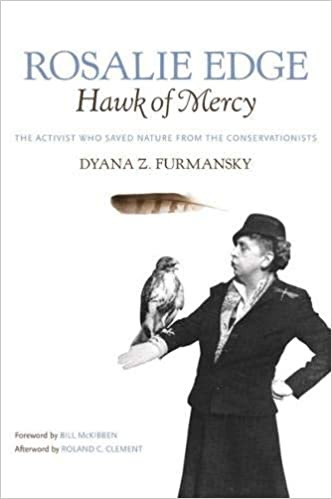
Rosalie Edge: Hawk of Mercy by Dyana Z.Furmansky

Summary (from Amazon): Rosalie Edge (1877-1962) was the first American woman to achieve national renown as a conservationist. Dyana Z. Furmansky draws on Edge’s personal papers and on interviews with family members and associates to portray an implacable, indomitable personality whose activism earned her the names “Joan of Arc” and “hellcat.” A progressive New York socialite and veteran suffragist, Edge did not join the conservation movement until her early fifties. Nonetheless, her legacy of achievements―called "widespread and monumental" by the New Yorker―forms a crucial link between the eras defined by John Muir and Rachel Carson. An early voice against the indiscriminate use of toxins and pesticides, Edge reported evidence about the dangers of DDT fourteen years before Carson's Silent Spring was published.

Today, Edge is most widely remembered for establishing Hawk Mountain Sanctuary, the world's first refuge for birds of prey. Founded in 1934 and located in eastern Pennsylvania, Hawk Mountain was cited in Silent Spring as an "especially significant" source of data. In 1930, Edge formed the militant Emergency Conservation Committee, which not only railed against the complacency of the Bureau of Biological Survey, Audubon Society, U.S. Forest Service, and other stewardship organizations but also exposed the complicity of some in the squandering of our natural heritage. Edge played key roles in the establishment of Olympic and Kings Canyon National Parks and the expansion of Yosemite and Sequoia National Parks. Filled with new insights into a tumultuous period in American conservation, this is the life story of an unforgettable individual whose work influenced the first generation of environmentalists, including the founders of the Wilderness Society, Nature Conservancy, and Environmental Defense Fund.

Reviews:

https://greengroundswell.com/rosalie-edge-hawk-of-mercy-book-review/2013/08/22/

(wikipedia)

Articles:

1. Audubon: https://www.audubon.org/news/unpacking-rosalie-edge-slowly-stories-hawk-mercy-doesnt-tell

2. Million Trees: https://milliontrees.me/2014/09/12/rosalie-edge-conservation-hero/

Archive Catalog of Bird Lore written by Frank Chapman for NAAShttps://catalog.hathitrust.org/Record/000497136

Pelican Island in Floridahttps://www.fws.gov/refuge/pelican_island/about/history.html

History of National Association of Audubon Societies (NAAS)https://www.audubon.org/about/history-audubon-and-waterbird-conservation

Videos and Interviews with Author:

1. By her daughter: https://www.youtube.com/watch?v=jk3DMgvquTI

2. U.S. Fish and Wildlife Service: https://www.facebook.com/watch/live/?v=300224014335245&ref=watch_permalink

3. Hawk Mountain: https://www.youtube.com/watch?v=iVHIXqJYanA

4. Wildlife Center in VA: https://www.wildlifecenter.org/episode-13-hawks-falcons

Hawk Mountain Sanctuary Website: https://www.hawkmountain.org/

Discussion Questions: 

1.  Discuss who Edge was and how she became a "citizen-scientist and militant political agitator".  What events influenced and "awakened"her?  Discuss her travels, writings, involvement with the suffragette movement, social life, marriage, children, etc.

2.  Discuss the origins and evolution of The National Association of Audubon Societies (NAAS) organization, "the nation's oldest, largest, wealthiest and most prestigious bird protection organization", including its early leaders such as Grinnell, Chapman, and Pearson.  Discuss NAAS' relationship with the AOU (American Ornithological Society), the American Museum of Natural History and Bureau of Biological Survey as well as the Winchester Arms Co. and the Vermilion Bay Hunt Club and the conflicts that ensured.  (p. 98-)

3.  What does "conservation" mean to you?  What does the term "sentimentalist" mean?  What does "preservationist" mean?

4.  In 1929, Edge received a package in Paris containing the pamphlet, "A Crisis in Conservation".  Discuss why it was written, what event provoked it to be written and who were the writers.  What impact did it have on Edge?  (p.88-, 106-)

5.  Discuss Edge's relationship and interactions with the NAAS Board including her writings and the various people she worked with including Hornaday, Van Name and Brant and even Peterson and how it led to her founding the ECC (Emergency Conservation Committee).  (p. 110-, 118-, 124)

6.  Why does Edge hire the cofounder and director of the ACLU, Roger Baldwin, to represent her in a lawsuit against the NAAS?  What is the result and impact?  (126-) Discuss further major events that she fought against including the Rentals of Sanctuary in the NAAS budget, (p. 138), Yellowstone's pelicans (p. 141), fur trapping, Bear Refuge (p. 140), and King's Canyon (p. 228-), etc.

7.  The term ecosystem was not readily used in the early 1900s but Edge evokes this concept at NAAS meetings and congressional hearings.  (p. 143-) What impact and vision did it provide?

8.  Edge kept her activist and social lives separate.  At the Colony Club though, she was once asked, "What do you do when you look at a bird?"  (p. 150)  How would you respond?

9.  Discuss Edge's creativity, advocacy work, and navigation of numerous relationships (Van Name, Secretary Ickes, Brant, Superintendent Thompson, etc.) from creating the Hawk Mountain Sanctuary to helping create the Olympic National Park and also saving the Yosemite Sugar Pines.

10.  What impact did Edge have on the conservation movement as a whole and which organizations and individuals continued the fight, who were inspired by her?


(Audubon.org)